Every shelter frame needs something underneath it, and a shipping container is just one way to provide that support. Poles, concrete blocks, and walls all do the job too, and which one makes sense usually gets decided by the site itself: how much room there is, what’s already built, and what the covered space needs to handle once it’s up.
Below, we cover the shelter mounting options NZ sites use most: container, pole, wall, and combination setups, along with key site details to sort out before installation.
What Are Shelter Mounting Systems?
Mounting describes how a shelter’s frame is supported and secured, whether to the ground or to an existing structure. The arches, purlins, frame, and cover remain largely the same across our range. What actually changes is what holds the shelter up: shipping containers, steel poles, a concrete block wall, or a combination of the three. Since the right answer depends on available footprint, ground conditions, and how the covered space gets used day to day, one property’s ideal setup won’t necessarily suit the next.
Container-Mounted Shelters
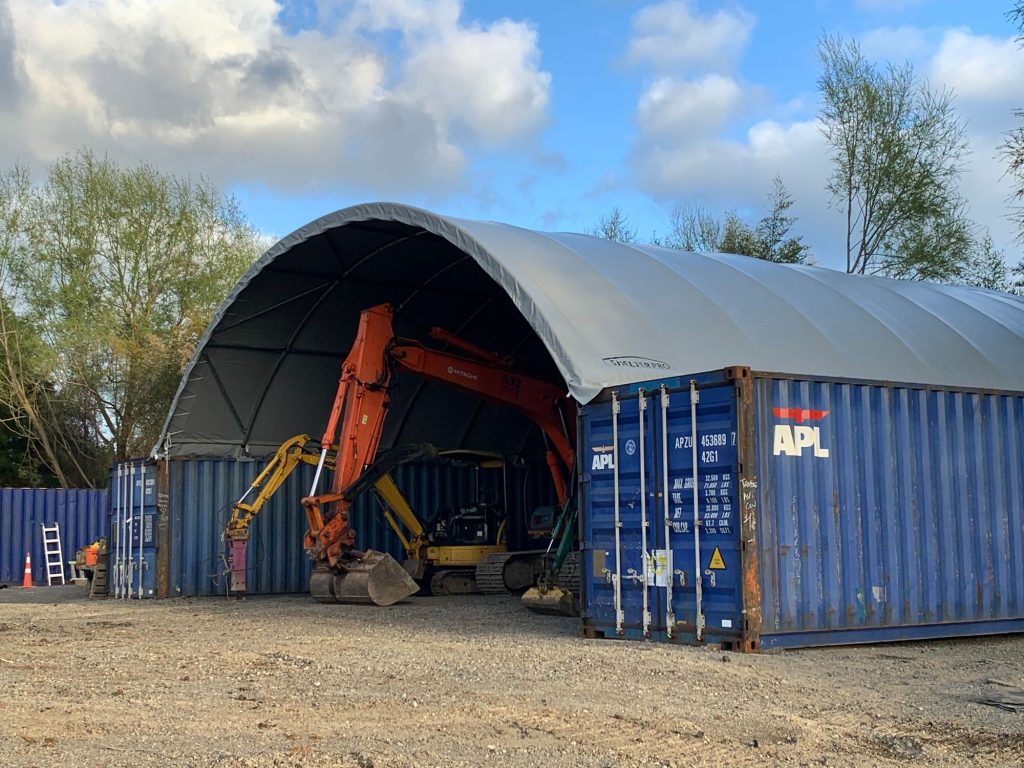
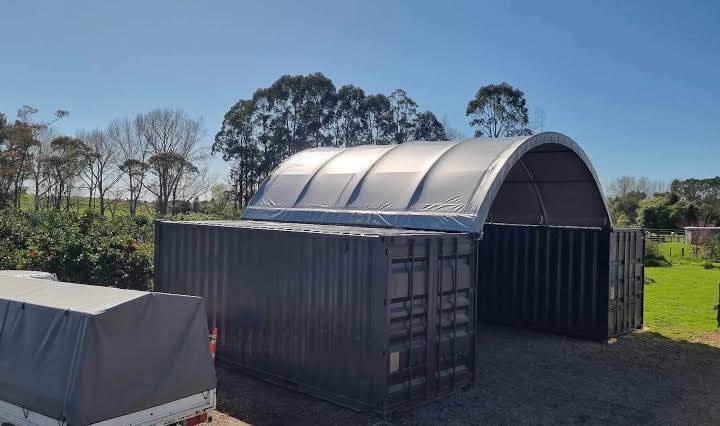
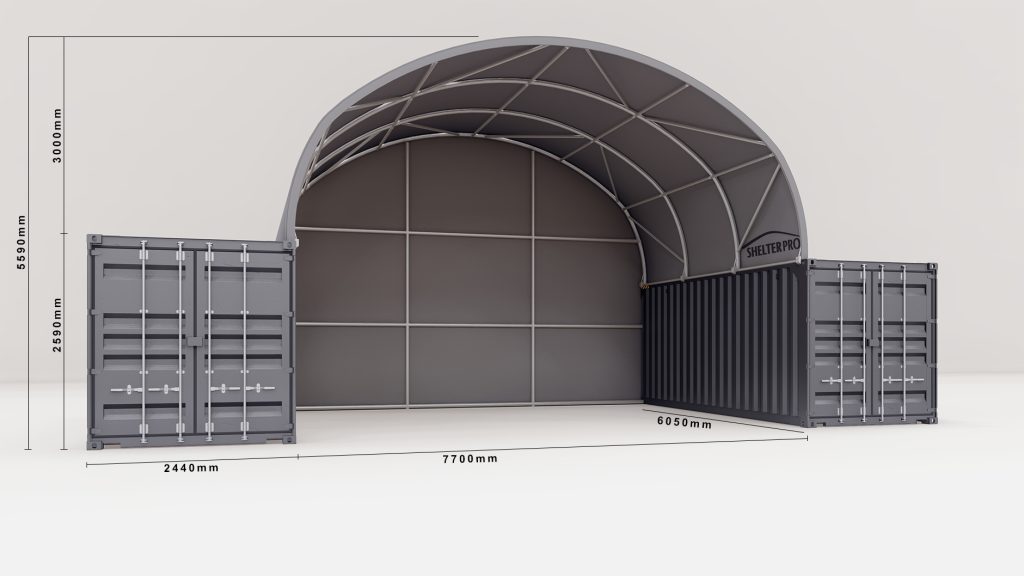
Container mounting is what most people picture when they think of a container shelter, and it remains the option we supply most often. The full detail sits on our container-mounted installation page, but the basic idea is simple enough: two shipping containers are set apart at a fixed distance, and the frame spans the gap between them to form a large covered area underneath. Containers make a naturally solid foundation, being heavy and stable without needing additional footings, and they double as lockable storage in the bargain. Businesses often choose this setup for workshops, vehicle service bays, and general storage—gaining both a covered work area and lockable storage within the same footprint. Containers relocate without much disruption too, so the configuration suits temporary sites and fixed-term contracts as well as a permanent yard, and where overall width is tight, shelters can mount on the outside edges of the containers rather than spanning between two of them.
Pole-Mounted Shelters
Where containers aren’t available, aren’t needed, or simply don’t suit the site, a pole-mounted or freestanding shelter becomes the more sensible alternative. Rather than being tied to container placement, the shelter sits on steel poles instead, opening up the space underneath and around it and improving both air circulation and natural light. With entrances able to run along both the sides and ends, access tends to feel more open than a container-mounted equivalent, and the overall footprint often ends up smaller.
This option comes up constantly in farming, covering livestock, feed pads, calf rearing areas, and hay storage, though it’s just as commonly used for vehicle, boat, and RV storage, where an open-sided structure suits the job better than a lockable one. Pole positions and fixings still need working out against the specific site and shelter size, which is exactly where our engineers can help.
Wall and Block-Mounted Shelters
The third option attaches a shelter to concrete blocks or an existing wall rather than to containers or poles, and it’s covered in more depth on our block and wall-mounted page. It’s a common choice among mining operations, landscape supply yards, and farms that need fast, durable storage bays for aggregate, feed, or waste materials. Concrete blocks are set at whatever width the job calls for, with the shelter mounted above to form one or several covered bays, and half end panels can be added afterwards to close in the arch if extra protection is needed.
Set against a building in brick and mortar, this approach is cheaper, faster to erect, and can be resized or relocated later as needs shift, making it a natural fit for waste transfer stations, bunker storage, and general yard cover wherever quick, durable protection matters more than a fully enclosed building.
Combination Mounting: Containers, Poles and Walls
One of the more useful things about our shelters is that they aren’t locked into a single type of support. A container and pole mounted shelter is a common example, using a container on one edge and poles on the other, and it works particularly well when a site only has room for one container or the layout won’t allow for two. The result still delivers the same covered area and structural stability as a fully container-mounted setup, just carried on a smaller footprint at one end.
Because any of these configurations can be applied across our full shelter range, in both 20ft and 40ft container widths, a mixed setup is never limited to a particular model. If your site has restricted space, it’s worth raising a combination mounting option early, since it often solves a layout problem no single mounting type can manage on its own.
How to Choose the Right Mounting Option
No single mounting type suits every site, so the decision tends to come down to a handful of practical factors working together.
Start with the footprint you actually have to work with. A tight site might rule out two full-size containers, but it can still handle a container-and-pole combination or a pole-mounted layout comfortably. From there, think about what needs to fit underneath, whether that’s machinery, stock, vehicles, or bulk material, and whether the shelter should be open-sided or would benefit from lockable storage instead. Access matters just as much, particularly if vehicles need to pass through regularly rather than simply park underneath. In practice, what you’re storing often does most of the deciding on its own: livestock and vehicles tend to suit pole-mounted setups, while aggregate, waste, and bulk product point toward wall or block mounting.
Existing structures on site can shape the decision too. A concrete block wall already in place often makes block mounting the more practical route, while a bare paddock tends to point toward poles or containers instead.
What Should Be Confirmed Before Installation?
A handful of details need to be locked in before any mounting configuration can go ahead. Site measurements come first, since the space available determines which mounting types are viable at all. Ground conditions matter just as much, particularly for pole mounting, where fixings need to suit the soil rather than rely on a generic assumption. Where containers form part of the setup, their placement and spacing need to match the shelter’s dimensions precisely, and access for delivery vehicles is worth confirming well ahead of time.
This is planning information rather than a step-by-step installation guide, since our team handles the mounting and installation itself. The goal is simply making sure the site is ready and the configuration agreed on before the shelter arrives.
Custom Shelter Mounting with ShelterPro
Not every site fits neatly into a standard mounting type, and that’s where a custom configuration earns its place. Our team can work through your available space, what the shelter needs to cover, and any existing structures, then help you land on whether a container, pole, wall, or combination mounting makes the most sense. Custom pole fixings and layouts can also be engineered for unusual dimensions, so you’re never forced into a setup that doesn’t quite fit.
FAQs
Can a shelter be mounted without shipping containers?
Yes, and it’s more common than people expect. Pole and wall mounting are both available alongside container mounting, with the right method depending on the site.
Can a shelter be mounted using one container and poles?
It can, and this is actually a standard configuration for sites with room for only one container. One edge sits on the container, while the other rests on poles, still delivering a fully covered area.
Can a shelter be attached to an existing wall?
Shelters can be mounted to concrete blocks or walls to create covered storage bays, most commonly for aggregate, waste, or bulk material, though the setup needs assessment for the specific site first.
How do I know which mounting option is right for my site?
Start with the available space, what needs to go underneath, access requirements, and any existing structures, then take the layout to our team before anything is ordered.
Can mounting options be customised?
They can. Beyond the standard container, pole, and wall options, we work through custom configurations, including combination mounting, for restricted or unusual sites.
A few more mounting questions come up regularly, and our FAQs page covers the wider list.
Not sure which mounting setup will work for your site? Get in touch with our team and share your available space, intended use, and the shelter configuration you have in mind, and we’ll help you work out what fits.